Gasket sealants offer a quick, do-it-yourself option for minor head gasket leaks, cracked blocks, or warped heads. The right product can save time and money by providing a reliable, temporary or permanent seal without full engine disassembly. Below are five strong choices that cover different needs—from simple pour-in fixes to durable, long-term seals. Each option is compatible with common antifreeze formulations and designed for multiple engine sizes. Use this guide to compare sealing power, ease of use, and suitability for your vehicle’s make and model.
| Product | Brand | Key Benefit |
|---|---|---|
| Bar’s Leaks HG-1 HEAD SEAL | Bar’s Leaks | Fastest solution for blown head and intake gasket leaks; antifreeze compatible |
| K-Seal ST3501 Pour and Go | K-Seal | Permanent seal with ceramic micro-fibres; easy, no drain or flush |
| BlueDevil Head Gasket Sealer | BlueDevil Products | Permanent seal; versatile for blown gaskets, heads, heater cores |
| Permatex 81630 Ultra Red | Permatex | High-temperature gasket maker; OEM-specified and sensor-safe |
| Steel Seal Blown Head Gasket Fix 8 Cylinder | STEEL SEAL | Permanently seals a crack; DIY pour-in solution used by shops |
Bar’s Leaks HG-1 Head Seal Review

Bar’s Leaks HG-1 is designed to address blown head and intake gasket leaks quickly. Its primary claim is a fast, safe solution for coolant-related gasket issues, with compatibility across antifreeze types and a requirement that the engine can idle for about 15 minutes without overheating. The product is formulated to seal warped or cracked heads and blocks under typical driving conditions, without needing a coolant drain or thermostat removal. Its broad compatibility with 50-50 coolant mixes makes it a versatile option for many passenger cars and light trucks.
K-Seal ST3501 Pour and Go Head Gasket Sealer
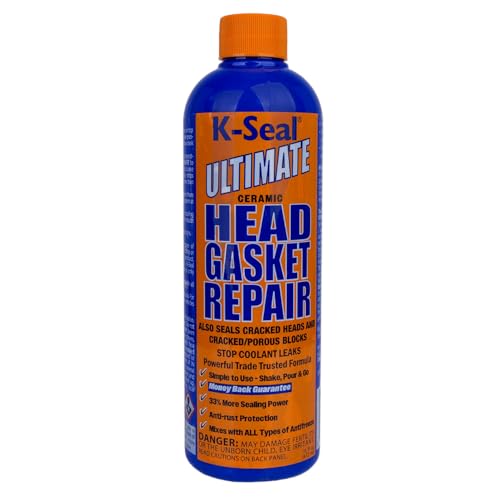
K-Seal ST3501 emphasizes a permanent repair with a formula described as offering 33% more sealing power than standard variants. The ceramic micro-fibres enable sealing of leaks up to 0.64 mm without harming the engine. The product is designed for ease of use—no draining or flushing required; you simply shake, pour, and run the engine as normal. For larger engines such as heavy-duty trucks or plant machinery, the manufacturer suggests using two bottles for optimal results. This makes K-Seal suitable for a broad range of vehicles and scales of operation.
BlueDevil Head Gasket Sealer – 1 Quart

BlueDevil’s Head Gasket Sealer is positioned as a user-friendly sealant that aims for a permanent fix. It’s designed to seal leaks in blown head gaskets, as well as warped or cracked heads, heater cores, and freeze plugs. The product’s broad compatibility, including various gasoline and diesel engines, makes it a versatile choice for a wide array of vehicles. The emphasis on a permanent seal and sensor-safe formula aligns with users who want a long-term solution with minimal tool requirements or expertise.
Permatex 81630 Ultra Red High Temp Gasket Maker

Permatex Ultra Red is a high-temperature gasket maker designed for tough automotive environments. It offers strong adhesion, flexibility, and OEM-specified performance with sensor-safe properties. This product is suitable for sealing where high heat is a factor, such as exhaust manifolds and engine components, and provides a non-flammable, non-toxic formulation. It’s ideal for users who need a reliable gasket maker for temporary or maintenance sealing tasks that involve high temperature exposure and exposure to oils and cooling systems.
Steel Seal Blown Head Gasket Fix 8 Cylinder

Steel Seal’s Blown Head Gasket Fix for 8-cylinder engines is marketed as a permanent, do-it-yourself solution. It highlights a widespread adoption by repair shops nationwide, underscoring its practical credibility for customers seeking a durable repair without vehicle downtime. The product is designed to pour into the cooling system, sealing head gasket cracks and leaks with a triple-patented formula. It targets users who want a proven, shop-tested option that works across a range of engine sizes in the eight-cylinder category.
Buying Guide: Key Considerations For Choosing The Best Gasket Sealer
- Engine type and size: Choose a formula recommended for your engine displacement and cylinder count. Some products are optimized for smaller engines, while others are rated for larger blocks.
- Leak severity and location: For minor leaks, a quick pour-in solution may suffice. For severe leaks or cracked blocks, a permanent sealant with higher sealing power is often necessary.
- Durability vs. ease of use: Permanent sealants can reduce the need for future maintenance but may require more careful compatibility checks with antifreeze types. Simpler solutions trade longevity for easy, quick fixes.
- Engine cooling system compatibility: Ensure the product is compatible with your coolant type (50-50 mixes, OAT/HOAT, etc.) and does not require coolant draining unless specified.
- Vibration and heat tolerance: For high-vibration environments, look for formulations designed to resist oil and coolant exposure while maintaining adhesion under engine heat.
- Manufacturer guidance and warranty: Review usage instructions and any warranty or performance claims. Some products advise using additional bottles for larger engines.
- Tooling and preparation: Most options require no special tools, but following steps such as running the engine to operating temperature is essential to activate the sealant.
- Long-term maintenance: A permanent sealant may reduce leakage but may not fix underlying issues entirely. Consider professional evaluation if leaks recur after sealing.
- Vehicle age and emissions compliance: Some sealants can interact with emissions hardware. Check product data sheets for compatibility with engine management systems.
- Cost vs. risk: Compare the price of a sealant against potential shop repairs. Weigh the probability of a successful seal against the engine’s current condition.