Choosing the right gas caddy for boat use combines portability, spill prevention, and efficient transfer. The following five products are selected for marine-friendly performance, durable construction, and practical transfer options. Each option supports gravity flow or siphon pumping, with some models offering built-in electric pumps for quick refueling. Read on to compare capacities, safety features, and handling in wet, windy, or dockside conditions.
| Product | Capacity | Transfer Type | Key Benefit |
|---|---|---|---|
| PAMBEE 15 Gallon Gas Can | 15 gal | Siphon / Gravity | High capacity with wheel portability |
| Garvee 16 Gallon Gas Can | 16 gal | Manual siphon | Heavy-duty HDPE with dual shut-off valves |
| LAUCO Portable Marine Fuel Tank | 6.34 gal | Transfer hose | Marine-optimized vent/seal system |
| Euker 15 Gallon Gas Can | 15 gal | Gravity / Manual siphon | Anti-static grounding and dual shut-offs |
| Garvee 15 Gallon Gas Can With Pump | 15 gal | Manual pump | Durable build with leak-proof design |
The products below are arranged to help you compare capacities, usability on boats, and how each handles the common marine fueling tasks, from docking to remote shore refueling. Safety features such as vapor-tight seals, child-resistant caps, and anti-static grounding are highlighted where present. No matter your vessel size, there’s a gas caddy option here to minimize spills and simplify fueling.
PAMBEE 15 Gallon Gas Can With Siphon Pump

The PAMBEE 15-gallon gas can is designed for versatility and reliability on the water and away from shore power. Constructed from high-density polyethylene, the container resists rust and corrosion, making it suitable for diesel or gasoline storage under marine conditions. A 10-foot hose provides flexible reach, and the siphon pump offers a flow rate that helps you refuel boats or other equipment quickly. The wheel-equipped design improves portability on docks or in boatyards, and the built-in hose holder keeps hoses neatly stowed when not in use. This unit is well-suited for mid-size boats, ATV towing to remote launch sites, or longer dockside refuels where a larger capacity matters.
Features and considerations:
– 15-gallon capacity for multiple refuelings
– Heavy-duty HDPE construction provides durability and corrosion resistance
– 10-foot hose with a hose holder for storage
– Siphon and gravity refueling options offer flexible transfer
– Top handle and 6-inch wheels improve transport across docks
Garvee 16 Gallon Gas Can With Durable Build
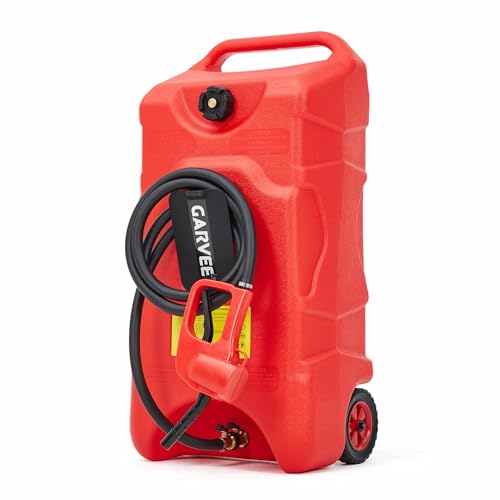
The Garvee 16-gallon gas can pairs rugged construction with practical safety features. Built from industrial-grade HDPE, this can withstand outdoor use on boats, farms, or maintenance sites. Dual shut-off valves and vapor-tight seals help prevent spills, while a child-resistant cap and anti-static grounding make it safer for home or workshop environments. An ergonomic, handheld transfer pump and a flexible hose with 360° rotating nozzle support efficient refueling of generators, boats, tractors, and more. This is a strong choice for boaters who need higher capacity and robust safety design for frequent take-ons and long trips on water.
Key points:
– Large capacity supports extended runs between refills
– Tight-seal design minimizes vapor release and leaks
– Dual shut-offs and grounding for spill prevention
– Flexible hose and rotating nozzle simplify refueling in tight spaces
LAUCO Portable Marine Fuel Tank Caddy

The LAUCO marine fuel tank focuses on compact, portable storage with marine-friendly details. With a 6.34-gallon capacity, it’s sized for smaller boats or as a reserve tank at the dock. Two notable design choices are a sealed or vented tank cap option to balance pressure during transfers and a 9.8-foot hose compatibility with common marine interfaces. The HDPE construction resists aging, impact, and corrosion, and the unit is designed to hold up under outdoor marine conditions. It’s ideal for outboard motor fueling or on-board fuel management without needing a large, heavy cannister.
Highlights:
– Dual cap options (sealed or vented) to manage airflow
– 9.8-foot hose for reach and compatibility
– Lightweight, durable marine-grade material
– 6.34-gallon capacity for compact use
Euker 15 Gallon Gas Can With Transfer Pump

The Euker 15-gallon fuel caddy emphasizes a balance of capacity and safety features. Its heavy-duty HDPE body resists corrosion, while dual brass shut-off valves and vapor-tight seals help minimize spills. An anti-static grounding wire adds another layer of safety for volatile fuels, and a child-resistant twist cap protects households and workspaces. The transfer system includes gravity flow and a manual siphon pump with an ergonomic T-grip handle, plus an 18-inch reinforced hose with an auto-shutoff nozzle for controlled filling of equipment and boats. A robust option for boaters needing a mix of capacity, control, and safety features.
Notable aspects:
– 15-gallon capacity with dual shut-offs
– Vapor-tight seals and grounding for safer fuel handling
– 18-inch reinforced hose with auto-shutoff nozzle
– Gravity flow and siphon transfer options
Garvee 15 Gallon Gas Can With Pump

This Garvee model combines practical design with a 15-gallon capacity and a manual transfer pump. The heavy-duty construction ensures durability in outdoor environments, and the dual shut-off valves along with vapor-tight seals help minimize leaks. The 10-foot hose provides a good reach for refueling boats, mowers, and other equipment without needing to move the can frequently. The design aims for stable refueling, with a focus on leak prevention and safe handling during transport and operation.
Buying Guide
- Capacity needs: If you regularly refuel multiple pieces of equipment or larger boats, choose 15–16 gallon models. For smaller boats or dockside refueling, 6–9 gallon options can be sufficient and easier to transport.
- Transfer method: Decide between gravity, siphon, or electric pump. Siphon or gravity modes work well on docks or uneven surfaces, while electric pumps speed up refueling for frequent use.
- Safety features: Look for vapor-tight seals, dual shut-off valves, anti-static grounding, and child-resistant caps. These features reduce spills and improve overall safety near water and on deck.
- Durability: Marine environments demand UV resistance, corrosion protection, and impact resistance. HDPE is common; ensure braces and wheels are robust enough for dock conditions.
- Portability: Wheels, top handles, and balanced weight distribution matter for moving fuel across docks, boat launches, or garages.
- Compatibility: Ensure hose length and nozzle type fit your transfer targets, including outboard tanks, generators, or onboard fuel tanks.
- Maintenance: Choose designs with easy hose storage, cleanable nozzles, and simple cap mechanisms to prevent buildup of residue or blockages.
- Storage considerations: Keep cans away from direct sunlight when possible and store upright to prevent leaks and fumes from escaping in tight spaces.