When a check engine light appears, a reliable fault code reader can pinpoint the issue, read live data, and guide quick repairs. The following five OBD2 scanners are among the most capable options for American drivers, balancing ease of use, broad vehicle compatibility, and helpful DTC databases. Each provides code reading, clearing functions, and diagnostic insights without professional equipment. The selection covers budget-friendly models, feature-rich tools, and options suitable for DIYers and casual motorists alike.
Summary of chosen products:
| Product | Brand | Key Features | Notes |
|---|---|---|---|
| ANCEL AD310 Classic Enhanced Universal OBD II Scanner | ANCEL | Reads/clears codes, live data, I/M readiness, freeze frame; compact and sturdy | |
| VDIAGTOOL VD10 | VDIAGTOOL | Reads/clears codes, DTC lookup, I/M readiness, TFT display | User-friendly for DIYers |
| MOTOPOWER MP69033 | MOTOPOWER | 9 protocols, live data, freeze frame, multilingual display | |
| FOXWELL NT301 | FOXWELL | Read/clear codes, live data, MIL reset, VIN retrieval | |
| ANCEL AD410 Enhanced OBD2 Scanner | ANCEL | Comprehensive OBDII diagnostics, EVAP/O2 tests, MIL reset indicators | Engine-focused with advanced diagnostics |
ANCEL AD310 Classic Enhanced Universal OBD II Scanner

The AD310 is a compact, single-connection OBD2 scanner designed for quick fault code reading and clearing. It supports 1996 and newer OBD2 vehicles and provides access to emission system trouble codes, live data, freeze frame information, and I/M readiness statuses. Its portability and all-in-one design make it a practical first-choice tool for home mechanics. The device powers directly from the vehicle’s OBDII port, eliminating the need for extra batteries. Pros include a sturdy build, clear labeling, and fast, reliable results that help identify repairs without specialty equipment. Some users appreciate Scotty Kilmer’s endorsement, which reflects widespread consumer confidence in its ease of use.
Performance notes: The AD310 offers straightforward troubleshooting feedback, enabling users to confirm repairs and verify emissions readiness after fixes. The 2.5-foot cable helps reduce tugging and accidental drops during in-vehicle testing. While not a full system scanner, it excels at engine and emissions diagnostics and is ideal for quick checks and routine maintenance tasks.
VDIAGTOOL VD10 OBD2 Scanner
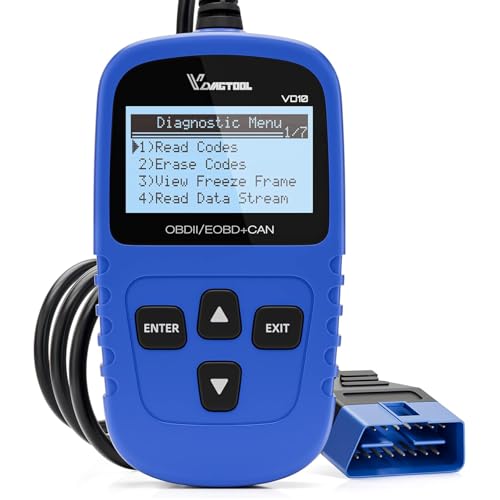
The VD10 is pitched as a user-friendly DIY tool that delivers essential diagnostics with a robust feature set. It reads and clears codes, shows live data, and supports I/M readiness checks. The built-in DTC database helps users interpret fault codes without needing to search online, saving time during troubleshooting. The interface is designed for quick navigation, making it suitable for car owners who want a straightforward diagnostic experience. It covers a wide array of OBDII vehicles and provides quick feedback on engine health and potential repairs.
Strengths include an intuitive workflow, rapid retrieval of error codes, and a data-rich display that supports troubleshooting through clear code definitions. Limitations may involve deeper manufacturer-specific faults or advanced parameter testing that require more specialized tools.
MOTOPOWER MP69033 Car OBD2 Scanner

The MP69033 offers a multi-function approach with a broad protocol reach, covering 1996 US-based, 2000 EU-based, and various newer CAN vehicles. It provides DTC lookup, live data, I/M readiness, and data flow with real-time curves. The 2.8″ LCD display is easy to read, and no external power source is required since power is drawn directly from the OBDII port. This scanner is well-suited for users who want a balance of cost and capabilities, enabling rapid fault code interpretation and diagnosis across a wide vehicle pool.
Considerations include the breadth of supported protocols and languages, which makes it a strong generalist tool. For advanced diagnostics (abs, transmission, or bi-directional control), a higher-end model might be necessary.
FOXWELL NT301 OBD2 Scanner

The NT301 is a professional-grade yet accessible diagnostic tool that focuses on CEL diagnosis, DTC reading, and I/M readiness for a broad range of vehicles. It reads live data streams, provides VIN retrieval on supported models, and offers a MIL (check engine light) reset after repairs. The device is designed for vehicle owners and DIYers who want reliable, mechanic-grade capabilities without ongoing subscription costs. Its limitations include not supporting advanced systems like ABS, SRS, or battery registration in some cases, but it remains an excellent choice for standard engine diagnostics and emissions readiness checks.
Overall, the NT301 delivers solid diagnostic depth with a clear interface and responsive performance, making it a dependable option for routine maintenance and troubleshooting.
ANCEL AD410 Enhanced OBD2 Scanner

The AD410 expands on standard OBDII scanning with additional diagnostics, including enhanced OBDII testing, EVAP system checks, and O2 sensor assessments. It is designed to read and clear emissions-related codes, monitor readiness, and provide comprehensive fault code definitions from a large built-in DTC database. The tool is compatible with many 1996+ vehicles that use OBDII and CAN networks. While it emphasizes engine-level diagnostics, users should note that it does not provide full ABS/SRS or broader transmission system resets, focusing instead on engine and emissions health.
Pros include a strong emphasis on diagnostic depth with practical EVAP and O2 testing, helping users narrow down potential issues for repair and inspection readiness.
Buying Guide: Key Purchase Considerations
Purpose and scope: Decide whether you need basic code reading and clearing or deeper diagnostics like live data, freeze frame, and I/M readiness. Some models emphasize engine emissions and EVAP testing, while others provide broader system checks.
Vehicle compatibility: Most modern scanners support OBDII protocols, but ensure the device lists your vehicle’s make, model, and year. If you drive older or specialty vehicles, verify any unique connector requirements or supported protocols before purchasing.
User experience: Look for an intuitive interface, clear DTC definitions, and a readable display. TFT or color displays are helpful for interpreting data quickly. Some models offer multilingual support, which can matter for non-English-speaking users.
Power and connectivity: Many scanners draw power from the OBDII port, avoiding batteries and chargers. Others may offer wired or Bluetooth connections to a phone or tablet. Consider how you prefer to interact with the tool and whether you want ongoing data logging on a device or via an app.
Data access and updates: A robust built-in DTC database with frequent updates reduces the need to search online for definitions. Check whether the tool allows firmware updates and, if applicable, how easy it is to access live data graphs and history.
Value and limitations: Inexpensive models are great for occasional checks, but they may lack advanced features like ABS, SRS, or bi-directional control. Mid-range tools typically balance price and capability with stronger DTC databases and live data options. High-end scanners offer extensive diagnostics but come at a premium.
User support and reliability: Consumer reviews and professional endorsements can indicate reliability and long-term support. Tools backed by reputable brands with responsive customer service tend to deliver better value over time.
Warranty and return policy: Check warranty length and return options in case the device does not work with your vehicle or fails prematurely.