Engine compression restorer compounds are designed to seal worn piston rings and cylinder walls, potentially restoring lost compression and power. This article highlights five effective options for American drivers aiming to improve compression, reduce oil consumption, and quiet engine noise. Below you’ll find concise product profiles, an at-a-glance summary, and a practical buying guide to help you choose the right additive for your high-mileage or worn engine.
| Product | Brand | Typical Use | Notes |
|---|---|---|---|
| Rislone 4447 High Mileage Compression Repair with Ring Seal | Bar’s Leaks | High-mileage engines with uneven compression | Ring seal technology targets worn rings |
| Restore (00012) 6-Cylinder Formula | Restore | Cylinder restoration and lubrication | Restores compression and horsepower |
| Bar’s Leaks 1000 High Mileage Engine Repair | Bar’s Leaks | Compression, power, and seal restoration | Comprehensive performance blend |
| LubeTrek GT Metal Anti-Friction Conditioner & Restorer | LubeTrek | High-mileage engines; wear restoration | Fills micro pits; reduces friction |
| BG 109 Engine Compression Restorer | BG EPR | Large V8 engines and diesel compression | Quart size for larger engines |
These products target similar goals—improve compression, restore power, seal leaks, and reduce oil consumption—yet they use different chemistries and delivery formats. The table above provides a quick reference for comparing scope and intended engine types. Each option is widely used in consumer automotive settings and compatible with gasoline engines of typical American passenger vehicles.
Rislone 4447 High Mileage Compression Repair

Rislone 4447 is a concentrated blend designed for higher mileage engines that show decreased or uneven compression. It uses high-shear and premium polymers to renew worn seals between piston rings and cylinder walls, helping to restore lost compression. This restoration typically translates to improved engine power and smoother operation. The product aims to fill scratches and grooves in cylinder walls to stabilize compression across all cylinders, addressing a common cause of power loss in aging engines. Use as directed for best compatibility with high-mileage vehicles.
Restore 6-Cylinder Formula Engine Restorer

Restore 6-Cylinder Formula Engine Restorer & Lubricant is marketed for compressions and overall engine performance restoration. It focuses on restoring cylinder compression and horsepower, with a broad claim of improving engine performance. The formula is designed to support engines experiencing reduced compression and degraded power without requiring major mechanical interventions. It is suitable for use in many six-cylinder configurations, and is positioned as a straightforward option for drivers seeking a non-destructive approach to compression recovery.
Bar’s Leaks 1000 High Mileage Engine Repair
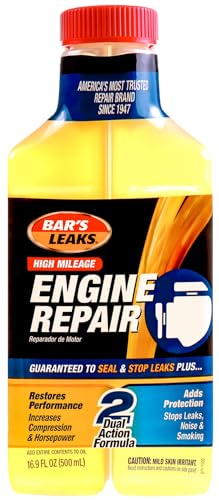
Bar’s Leaks 1000 combines additives intended to restore performance, increase compression, and improve horsepower. It is designed to reduce oil consumption, lower noise, and support worn cylinders, rings, bearings, and seals. The product is positioned as a practical option for vehicles exhibiting oil-related problems such as burning or leaks, with the aim of delaying more costly repairs by restoring critical engine sealing and improving overall efficiency.
LubeTrek GT Metal Anti-Friction Conditioner

LubeTrek GT Metal Anti-Friction Conditioner & Restorer is designed for high-mileage vehicles. Its formula aims to fix cylinder wear and scoring, fill micro pits, and improve compression. It also claims to reduce oil burning by repairing cylinder damage, which can contribute to lower oil consumption and decreased blue smoke. The product is marketed as an “overhaul-free” solution, suitable for engines that show wear and loss of compression while avoiding invasive mechanical repair in many cases.
BG 109 Engine Compression Restorer

BG 109 Engine Compression Restorer is available in a quart-sized bottle, making it convenient for larger engines such as big V8s and diesels. This size is positioned as economical for larger displacement engines, appealing to owners who need a substantial treatment for compression restoration. The product is marketed to save money over purchasing multiple smaller cans and aims to restore compression and improve engine performance through its formulation.
Buying Guide: Key Considerations And Comparisons
When selecting an engine compression restorer, consider the following factors to align with your vehicle’s needs and maintenance goals.
- Engine type and displacement: Larger engines (V8 and diesel) may benefit from quart-sized or higher concentration products and formulations designed for higher compression restoration.
- Mileage and wear level: High-mileage engines with worn rings and cylinders often respond to products that focus on sealing, micro-surface repair, and friction reduction.
- Recommended usage and dosage: Follow manufacturer directions for dosage and usage intervals to avoid over-application or potential harm to seals and gaskets.
- Compatibility: Check compatibility with your oil type and viscosity, along with any manufacturer advisories for engine components such as turbochargers or direct-injection systems.
- Observability of benefits: Look for indicators such as improved idle stability, smoother acceleration, reduced oil consumption, and lower exhaust smoke as practical signs of effectiveness.
- Longevity vs. short-term fixes: Some products provide quick compression boosts, while others focus on long-term wear mitigation. Decide based on the urgency of the issue and long-term maintenance plans.
- Cost-effectiveness: Compare bottle sizes and mixing requirements with expected engine life and maintenance schedule to determine overall value.
In practice, for high-mileage engines showing persistent compression loss, combinations of restoration products that address both sealing and wear can be considered. Always verify product compatibility with your vehicle’s engine type and consult a professional if uncertainty remains about engine health or if compression loss persists after treatment.