Choosing a reliable check engine light scanner helps you diagnose car trouble without a trip to the repair shop. The following five models are widely used, easy to use, and compatible with most 1996+ OBD-II vehicles. Each product section highlights what to expect, key features, and how it helps you read and reset codes, view live data, and monitor emissions readiness. A practical buying guide follows to help you weigh price, compatibility, and feature depth for common DIY needs.
| Product | Brand | Key Benefit | Typical Use |
|---|---|---|---|
| ANCEL AD310 | ANCEL | Fast live data and easy code clearing | Home diagnostics, quick CEL diagnosis |
| MOTOPOWER MP69033 | MOTOPOWER | Wide protocol support, large LCD | Multi-vehicle scanning, clear display |
| VDIAGTOOL VD10 | VDIAGTOOL | Built-in DTC definitions, user-friendly | DIY maintenance, fast fault code lookups |
| ANCEL AD410 | ANCEL | Comprehensive OBDII diagnostics, MIL reset | Broad compatibility, emissions focus |
| FOXWELL NT301 | FOXWELL | Live data graphs, VIN retrieval | Professional-style diagnostics at home |
ANCEL AD310 Classic OBD II Scanner

The ANCEL AD310 is a compact, value-focused OBD II scanner designed for quick fault code reading and clearing in 1996 or newer vehicles. It provides a straightforward CEL diagnosis, allows reading live data, freeze frame captures, and emissions-related I/M readiness. The device plugs directly into the vehicle’s OBD-II port, drawing power from the car and avoiding the need for separate batteries. Its sturdy build and clearly labeled buttons support fast, repeatable diagnostics for routine maintenance or post-repair verification.
MOTOPOWER MP69033 OBD2 Scanner

The MOTOPOWER MP69033 offers practical, all-around OBD-II functionality with a built-in DTC library, live data streaming, and a 2.8-inch LCD display. It supports nine protocols suitable for most 1996 US-based, 2000 EU-based, and Asian cars, including newer CAN models. It reads and erases codes, shows vehicle information, and provides real-time data with a simple, battery-free setup—power comes directly from the vehicle via the OBD-II port. It’s a solid option for everyday car owners who want clear results quickly.
VDIAGTOOL VD10 OBD2 Scanner
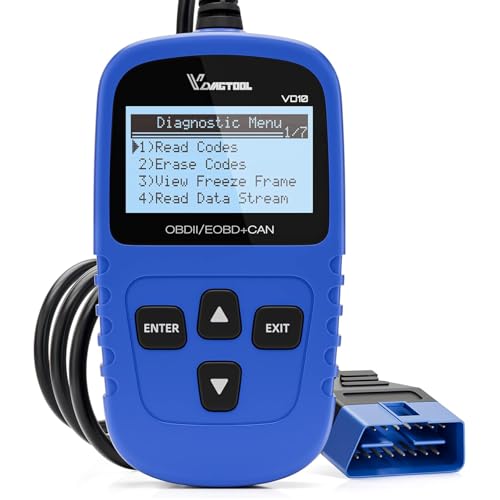
The VDIAGTOOL VD10 is designed for DIYers who want a straightforward tool that can read and clear codes, display live data, and show I/M readiness. It supports all OBD-II protocols and provides descriptive DTC definitions from a built-in database. With its user-friendly interface, users can quickly identify root causes and reset the MIL after repairs. The device emphasizes speed and reliability, making it a practical choice for casual car owners seeking a reliable diagnostic companion.
ANCEL AD410 Enhanced OBD2 Scanner

The AD410 from ANCEL pairs broad OBD-II support with enhanced diagnostics, including quick read and clear of fault codes, MIL reset, and monitor readiness checks. It adds advanced testing capabilities for O2 sensors and EVAP systems, helping pinpoint emissions-related issues. While designed for 1996+ vehicles, note that some limitations apply depending on the vehicle’s systems. It powers directly from the OBD-II port, offering a battery-free setup for convenient on-the-road checks and home troubleshooting.
FOXWELL NT301 OBD2 Scanner

The FOXWELL NT301 is a professional-grade OBD-II diagnostic tool designed for thorough CEL diagnostics. It reads and clears codes, accesses emissions readiness, and retrieves the VIN in supported vehicles. Live data streaming with graphing helps users identify trends and anomalies. It’s well-suited for enthusiasts who want more detailed insights, though it remains a consumer-friendly device that does not cover every system beyond OBD-II in all models. It emphasizes accuracy and robust data presentation for informed repairs.
Buying Guide: Key Purchase Considerations And Comparisons
- Vehicle compatibility: Most consumer OBD-II scanners work with 1996+ US-based, EU-based, and Asian vehicles. Confirm that your year, make, and model are supported, especially for advanced features like EVAP tests or VIN retrieval.
- Code reading and clearing: All five models read and clear generic codes. If you need manufacturer-specific codes or more extensive DTC definitions, consider scanners with larger built-in libraries (e.g., tens of thousands of codes).
- Live data and graphs: Real-time data helps diagnose intermittent issues. Graphing and data logging are especially useful for diagnosing sensor problems and performance trends over time.
- Emissions readiness: I/M readiness monitoring is valuable for preparing for smog tests. Some models emphasize this feature more than others, so check if your goal includes readiness verification.
- Ease of use: For DIY users, a clear display, intuitive menus, and a battery-free power design are helpful. Handheld devices with simple navigation reduce the learning curve.
- Expansion options: Some scanners offer broader diagnostics (O2 sensors, EVAP, VIN retrieval) or multi-language support. If you work on many vehicles or in multilingual contexts, these options increase versatility.
- Build quality and portability: Compact devices with sturdy cables resist drops and wear in a garage or driveway. Weight and dimensions affect handling during roadside checks.
- Price-to-feature balance: Higher-end models provide deeper diagnostics, but for general maintenance, mid-range devices often deliver the best value. Consider what features you actually need to avoid overpaying.
- Power source: Most readers draw power from the vehicle battery via the OBD-II port. Ensure your vehicle’s port is clean and accessible to avoid connection issues.
- Support and updates: Some brands offer ongoing DTC library updates and software refreshes. This can extend the scanner’s usefulness as new codes emerge with evolving vehicle tech.
When selecting a check engine light scanner, align the tool’s capabilities with your typical use: occasional maintenance, frequent DIY diagnostics, or professional-grade exploration. The models listed above provide a spectrum of entry-level to advanced features, helping you diagnose and address CEL issues without unnecessary complexity.