Finding a reliable tire pressure gauge is essential for safe driving, fuel efficiency, and tire longevity. This guide reviews five top car tire pressure gauges that blend accuracy, durability, and ease of use across a range of pressures and environments. Each pick works with standard Schrader valves and includes features that help you get quick, precise readings in daylight or darkness, hot or cold weather, and on the go.
| Product | Brand | Key Benefit |
|---|---|---|
| ETENWOLF T300 Digital Tire Pressure Gauge 3-200 PSI | ETENWOLF | Wide range with AI-assisted temperature compensation |
| ETENWOLF Tire Pressure Gauge 0-75 PSI | ETENWOLF | Large glow dial for night readability |
| JUSTTOP Digital Tire Pressure Gauge, 150 PSI | JUSTTOP | Four measurement units and auto standby |
| AstroAI Digital Tire Pressure Gauge 0-150 PSI | AstroAI | Backlit display and long-life AAA power |
| TireTek Premium Tire Pressure Gauge (ANSI Certified) | TIRETEK | ANSI certified accuracy, rugged mechanical build |
Note: Each product is selected for reliable accuracy, ease of use, and practicality for American drivers who value safe tire pressure monitoring across daily commuting, highway trips, and varied weather conditions.
ETENWOLF T300 Digital Tire Pressure Gauge

The ETENWOLF T300 uses a digital readout to deliver precise measurements from 3 to 200 PSI. It’s calibrated to ANSI B40.7 Grade 2A with a stated plus-minus of 0.5% for typical ranges, and it features a built-in AI chip with thermal compensation to function reliably in extreme temperatures (-4°F to 130°F / -20°C to 54°C). Notes indicate manual calibration and a general accuracy of plus-minus 1 PSI in practice. A comprehensive pressure range covers most vehicle, SUV, and light truck tires.
Key specifics include:
– Wide 3-200 PSI range suitable for cars, light trucks, and specialty tires.
– Thermal compensation for consistent readings in hot or cold weather.
– Replaceable batteries for extended use, and a robust build intended for frequent use.
ETENWOLF Tire Pressure Gauge 0-75 PSI

This heavy-duty gauge covers 0-75 PSI, a common range for passenger cars, motorcycles, and some light-duty trucks. It’s manually calibrated to ANSI B40.1 Grade A (plus-minus 1%), ensuring solid accuracy for everyday tire maintenance. The large glow dial provides visibility in low-light conditions, making it practical for early morning or nighttime checks. The gauge is built for durability and is suitable for garage or roadside use, with compatibility across a range of standard inflation applications.
JUSTTOP Digital Tire Pressure Gauge
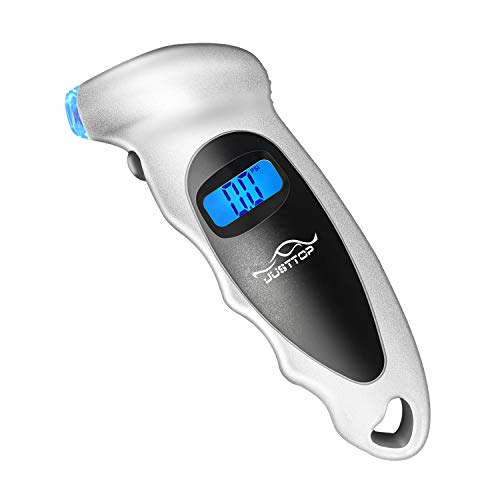
JUSTTOP’s digital gauge features a 150 PSI capacity with four units (psi, bar, kg/cm², kPa) and a backlit display for dark environments. It guides users through alignment of the pressure tap with the tire valve and delivers readings automatically. The unit supports continuous measurements without resetting to zero and includes auto shutoff after 30 seconds or a long-press shutdown for power savings. It’s designed for quick checks during daily driving routines and for users who prefer straightforward operation with multiple unit options.
AstroAI Digital Tire Pressure Gauge (0-150 PSI)

AstroAI’s digital gauge reads from 0 to 150 PSI with 0.1 PSI precision, featuring a backlit LCD and included Presta valve adaptor. It runs on two AAA batteries, offering straightforward replacement and longer service life. The gauge’s illuminated nozzle aids in placing a seal with the valve stem, delivering accurate measurements in dim light. It supports four measurement units and powers off automatically after a short period of inactivity to conserve energy.
AstroAI also offers a separate model with a glow dial and 0-150 PSI range, reinforcing its position as a versatile option for car, truck, and bicycle tires with a common user-friendly interface and reliable calibration practices.
TireTek ANSI Certified Premium Gauge
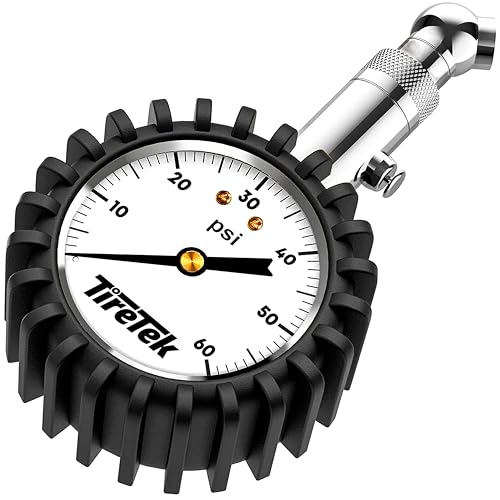
TireTek’s mechanical, analog gauge is ANSI certified to Grade A, offering a rugged, no-battery solution with reliable accuracy. Its 5mm extended chuck tip helps form a tight seal with the tire valve, reducing air leakage during measurement. The gauge is encased in a protective rubber sleeve for grip and durability, making it a robust option for garage use and field checks on cars, motorcycles, trucks, and other vehicles. This model emphasizes mechanical reliability and weather resilience, appealing to traditional users who prefer a tactile, battery-free instrument.
Buying Guide: Key Purchase Considerations
- Accuracy and calibration: Look for ANSI B40.1 or B40.7 standards and clear calibration details. Digital gauges often advertise tighter tolerances (e.g., ±0.5% to ±1%), while mechanical gauges rely on precision machining and build quality.
- Pressure range: Choose a gauge that covers your typical tire pressures. Cars usually require 28-35 PSI, but trucks, SUVs, and performance tires may demand higher ranges. Consider a dual-range or wide-range model for versatility.
- Display and readability: Backlit or glow dials aid visibility in low light. Digital displays provide precise increments (0.1 PSI). Ensure the display is easy to read with large digits and a clear unit indicator.
- Durability and construction: A rubberized housing, robust chuck, and weatherproof components help for roadside use and long-term reliability. Analog gauges have no power needs but rely on mechanical integrity.
- Power and battery life: For digital gauges, consider battery type (AAA vs. coin cell) and expected life. Some models support easy battery replacement to extend lifespan.
- Ease of use: Look for features like auto shutoff, multiple unit conversions, auto-zeroing, and quick-release or push-button operations for faster checks during routine maintenance.
- Valves and adapters: Compatibility with Presta valves is useful for bicycles; note whether adapters are included or sold separately.
- Portability: If you carry a gauge in your glove box or toolkit, a compact, lightweight model is preferable without sacrificing accuracy.
- Maintenance: Digital models may require periodic battery replacement and careful storage to prevent screen damage, while mechanical gauges may need occasional recalibration by a professional if used heavily.
In sum, the best car tire pressure gauge for you balances accuracy, user-friendliness, and durability for your typical driving scenarios. For American drivers, a blend of digital convenience and mechanical reliability often covers most needs, from daily commuting to weekend road trips across varied climates.