Infrared thermometers are essential tools for quick, non-contact temperature checks in automotive work. From engine components to exhaust manifolds and HVAC ducts, selecting a fast, accurate unit with reliable emissivity control and a solid distance-to-spot ratio helps diagnose problems and verify repairs. Below are five highly capable models that balance precision, durability, and practical features for automotive tasks.
Quick Reference
| Product | Brand | Key Benefit | Emissivity & Range | Notes |
|---|---|---|---|---|
| TempPro TP30 Infrared Thermometer Gun | TempPro | Wide range for automotive and kitchen | 0.1–1.0 emissivity; -58°F to 1022°F | 12:1 D:S; fast <500 ms |
| Klein Tools IR1 Infrared Thermometer | KLEIN TOOLS | Compact, precise, easy to target | Emissivity fixed with 10:1 D:S | Backlit display; laser targeting |
| KNINE OUTDOORS Infrared Thermometer | KNINE OUTDOORS | Excellent distance accuracy | 12:1 D:S; broad range -58°F to 1112°F | Single laser; versatile |
| Etekcity Temperature Gun Infrared Thermometer | Etekcity | Color LCD, wide range | Emissivity 0.1–1.0; -58°F–1130°F | Easy readability; oven use |
| NJTY Infrared Thermometer Gun | NJTY | High precision, fast | 13-point laser; -58°F to 1472°F | Industrial-friendly accuracy |
TempPro TP30 Infrared Thermometer Gun

The TempPro TP30 offers a versatile measurement range from -58°F to 1022°F, making it suitable for automotive diagnostics as well as food preparation tasks. It uses a modern thermopile sensor with ±1.5% accuracy and allows adjustable emissivity from 0.1 to 1.0 to better match metal, plastics, or painted surfaces common in vehicles. With a 12:1 distance-to-spot ratio and a response time under 500 milliseconds, it can quickly gauge engine manifolds, exhaust components, or cooling system surfaces from a safe distance. The unit supports a wide variety of materials, helping technicians compare readings across different automotive surfaces and environments.
Klein Tools IR1 Infrared Thermometer
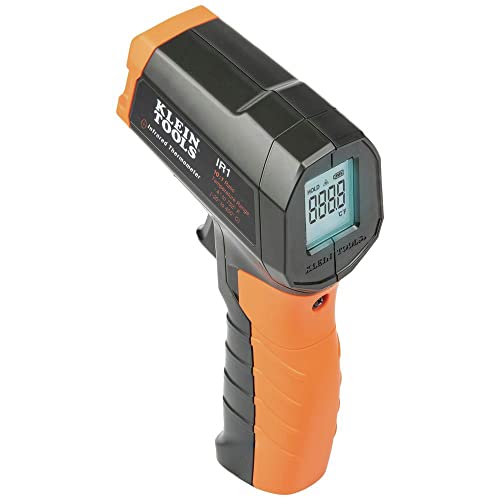
The Klein Tools IR1 focuses on precise, straightforward non-contact measurements with a 10:1 distance-to-spot ratio. Its broad -4°F to 752°F (-20°C to 400°C) range covers most automotive tasks, from cold-start diagnostics to warm engine components. Features include laser targeting and a backlit display for low-light conditions, plus auto power-off to conserve battery life. This model is well-suited for quick checks on alternators, radiators, and brake components where visibility or access may be limited. Emissivity is fixed but stable for common automotive materials, making it a dependable tool for routine maintenance checks.
KNINE OUTDOORS Infrared Thermometer Gun

The KNINE OUTDOORS model uses a 12:1 distance-to-spot ratio and a single laser targeting system to measure temperatures from a distance, reducing risk when assessing hot engines, exhaust manifolds, or HVAC ducts. With a range from -58°F to 1112°F, it covers extreme conditions encountered in automotive work. The single-laser setup helps you aim precisely at the intended surface, which is essential when dealing with small components or complex geometries. This unit is particularly useful for checking oven-related or vehicle heating components and other high-temperature surfaces.
Etekcity Temperature Gun Infrared Thermometer

Etekcity’s thermometer gun emphasizes an easy-to-read color LCD display and adjustable emissivity from 0.1 to 1.0, with an expansive -58°F to 1130°F range. Accuracy is listed at ±2%, which is typical for consumer-grade infrared units and adequate for most automotive temperature checks such as radiator outlet temperatures, intake manifolds, or cooling system hoses. The device is designed for practical use in ovens and engines alike, offering straightforward operation and reliable data presentation for quick diagnostics.
NJTY Infrared Thermometer Gun

The NJTY thermometer gun features a 13-point laser system and a rapid 0.5-second response time, delivering quick, precise surface readings suitable for automotive, HVAC, or kitchen applications. Its range extends from -58°F to 1472°F, enabling temperature checks on engine blocks, exhaust pipes, and high-heat components. Adjustable emissivity allows adherence to different surface materials, improving measurement accuracy on metals, alloys, and coated surfaces commonly found in vehicles. This model aims to balance speed with broad applicability for professional use.
Buying Guide: Key Purchase Considerations
- Temperature range: Choose a model that covers your typical automotive tasks, including high-heat exhaust components and cooling systems. The broader the range, the more versatile the unit.
- Distance-to-spot ratio (D:S): A higher D:S makes it easier to measure distant or hard-to-reach surfaces safely. For automotive work, 12:1 is common and effective.
- Emissivity control: Emissivity adjustment (0.1–1.0) improves accuracy on shiny metals and plastics. If you work with diverse surfaces, emissivity adjustment is highly beneficial.
- Accuracy and response time: Look for readings with fast response times and tight accuracy (e.g., ±1.5% to ±2%). This reduces guesswork during critical checks.
- Display readability: A backlit or color LCD helps in dim garages and under the hood. Quick-glance readings reduce disruption during diagnostics.
- Targeting aid: A built-in laser or dual lasers improve aiming precision, especially on small components or tight spaces.
- Power and durability: Rechargeable batteries or long-lasting cells are convenient. Durable housings and grip matter when used in workshop environments.
- Safety considerations: Non-contact measurements protect you from hot surfaces, moving parts, and harmful exposures. Always follow manufacturer guidelines for distance and use.
- Application versatility: Consider units intended for automotive use but also compatible with food, HVAC, and general home maintenance if you need a multi-use tool.
These infrared thermometers provide rapid surface readings, enabling quick diagnostics, preventive maintenance, and quality checks in automotive contexts. When choosing, align features with your most frequent tasks—engine bays, cooling systems, exhaust components, or electrical harnesses—to maximize utility and accuracy.