The right anti-sway bar system is essential for stable and predictable towing of travel trailers. This guide reviews five high-performing sway control kits designed to minimize trailer sway, improve handling, and enhance safety on highways and backroads. Each option features robust construction, straightforward installation, and compatibility with a range of weight distribution hitches. Explore these top picks to find the best match for your trailer size and towing setup.
| Product | Brand | Key Benefit | Towing Capacity (approx.) | Shank/Ball Type |
|---|---|---|---|---|
| CURT 17200 Trailer Anti-Sway Bar Control Kit | CURT | Improved control with brake-pad style sway deterrence | Compatibile with CURT weight distribution hitches | Hex nut toggle adjustment |
| CURT 17201 Trailer-Mounted Sway Control Ball | CURT | Direct trailer frame attachment for added sway control | Designed for use with sway control kit #17200 | Self-tapping bolts included |
| Dollate Weight Distribution Hitch With Sway Control | Dollate | Balanced weight distribution reduces sway and improves stability | Up to 14,000 lbs towing | 2-inch shank, standard ball |
| FAHKNS Weight Distribution Hitch With Sway Control | FAHKNS | High towing capacity with sway-resistant design | Up to 12,000 lbs (first FAHKNS listing) | 2-inch Shank, 2-5/16-inch Ball |
| GCCSJ Weight Distribution Hitch With Sway Control | GCCSJ | Forged alloy steel for durability and smooth towing | Up to 14,000 lbs | 2-5/16-inch ball |
Note: Specs above reflect listed product capabilities and common configurations. Always verify compatibility with your specific trailer, hitch, and vehicle before purchasing.
CURT 17200 Trailer Anti-Sway Bar Control Kit

CURT’s 17200 kit focuses on improved trailer control using a brake pad type sway material to limit lateral movement. The system is designed for versatile use across a wide range of weight distribution hitches, including most CURT models. It provides a straightforward hex nut toggle for adjusting sway restriction, allowing users to tailor resistance based on trailer type and load size. Installation should align with CURT hitch compatibility, and the kit is ideal for RVs and travel trailers frequently subjected to crosswinds or gusty highway conditions.
CURT 17201 Trailer-Mounted Sway Control Ball

The CURT 17201 ball attaches directly to the trailer frame to provide robust sway control in conjunction with the 17200 kit. Built from strong steel and including four self-tapping bolts, this option facilitates secure installation and dependable performance. It is best paired with compatible sway control components to maximize stability for longer trips or windy conditions, and it complements CURT’s broader sway control ecosystem for seamless integration.
Dollate Weight Distribution Hitch With Sway Control

The Dollate kit emphasizes optimized weight distribution to balance the trailer and towing vehicle. Its sway control bar and spring bar assembly work together to mitigate sway, improve steering, and enhance braking performance. With a towing capacity near 14,000 pounds and tongue weight support around 1,200 pounds, this setup aims to deliver a stable towing experience, especially useful for larger travel trailers on uneven roads or long-distance trips.
FAHKNS Weight Distribution Hitch With Sway Control
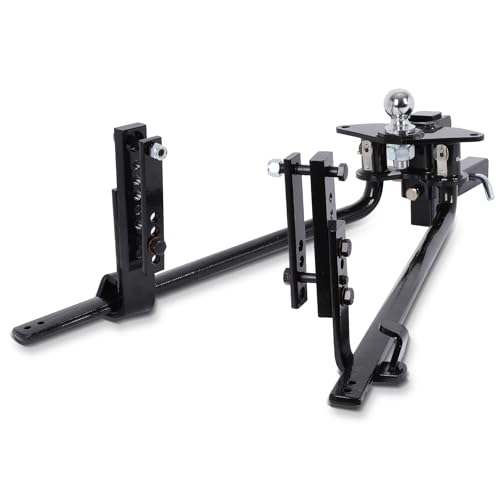
The FAHKNS system provides balanced weight distribution to improve steering sensitivity and reduce travel sway. With a towing capacity up to 12,000 pounds and tongue weight up to 1,200 pounds, it is designed to maintain trailer stability and reduce wobble during highway towing. The kit’s design focuses on easy installation and practical performance for RVs and campers undertaking longer journeys with varying loads.
FAHKNS Weight Distribution Hitch, Anti Sway Hitch for Travel Trailer

This FAHKNS model emphasizes horizontal towing by distributing weight across the trailer-vehicle pair. It includes sway counteraction components to enhance ride comfort and safety, with a towing capacity up to 12,000 pounds and tongue weight up to 1,200 pounds, making it a practical choice for mid-sized travel trailers and RVs requiring additional stability on the road.
Weight Distribution Hitch With Sway Control, GCCSJ

The GCCSJ anti-sway weight distribution hitch features forged alloy steel construction with corrosion-resistant coating for durability in harsh conditions. It supports up to 14,000 pounds of towing capacity and up to 1,200 pounds of tongue weight. Sway reduction is achieved through spring bars and an added sway control bar, with a design intended to deliver stable handling and directional control across varied road surfaces and weather.
Buying Guide: Key Purchase Considerations
- Trailer and hitch compatibility: Verify shank size, ball size, and hitch compatibility with your weight distribution setup. Some products are built to integrate with specific CURT hitches, while others are universal.
- Weight rating and tongue weight: Match the kit’s maximum towing capacity and tongue weight to your trailer’s GVWR and tongue weight to ensure safe operation.
- Adjustability and fine-tuning: Look for sway control systems that offer adjustable resistance to tailor stability for different road conditions and loads.
- Ease of installation: Consider whether the kit provides clear mounting hardware, self-tapping bolts, and straightforward adjustments for quick setup and field adjustments.
- Durability and materials: Forged steel and corrosion-resistant coatings extend life in salt, moisture, and UV exposure common on many travel routes.
- Maintenance needs: Some systems involve moving parts like spring bars and torsion components—check for lubrication needs and inspection intervals.
- End-use scenarios: For long hauls, crosswinds, or frequently changing loads, prioritize systems with robust sway reduction and reliable braking compatibility.